Showing posts with label Electricity Auto Hybrid. Show all posts

Sunday, January 24, 2010

Electricity Auto Hybrid


Electricity has been used to power transportation vehicles since the early 1900s. When used to power electric vehicles (EVs), electricity is stored in an energy storage device such as a battery. EV batteries have a limited storage capacity and their electricity must be replenished by plugging the vehicle into an electrical source. The electricity for recharging the batteries usually comes from coal, but renewable sources such as solar, wind, or geothermal energy can also generate electricity. The range of electric vehicles is limited; thus, they are particularly well suited to short-distance, high-use applications -- they frequently are used inside airports, on college campuses, or in parks or recreation centers. For regular city and highway driving, electricity can work in conjunction with a gasoline-powered engine, as in hybrid vehicles. Fourteen hybrid car models are available for sale today. In total, almost 300,000 American drivers own hybrid cars. For a list of hybrid vehicle makes and models, visit Discover Alternatives.
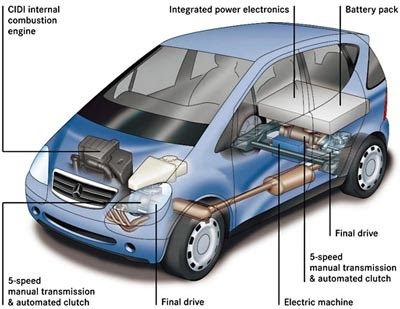
Hybrid power generation: Hybrid-electric vehicles refer to powertrains that use a battery-powered electric motor, a gasoline internal combustion engine, and a concept known as regenerative braking to power the vehicle. To optimize performance, emissions, and fuel efficiency, a computer manages the energy from these three systems. The computer senses the driving mode and the battery state of charge and then directs energy from either the battery system or the gasoline engine to the most appropriate drive train component, an electric motor or an engine drive shaft. Regenerative braking systems, which recover energy that is otherwise wasted, allow hybrids to be especially fuel-efficient in stop-and-go city driving. Utilizing these hybrid technologies, fuel economy can be improved by up to 25 percent over conventional automobiles.

Saturday, January 23, 2010

Plug in your hybrid, pollute less?

Do cars that run on electricity pollute less than those that run on gas?

Generally, yes, but the answer depends on where you live, say experts. It also depends on the type of electric-powered hybrid you drive.

Rising gasoline prices, combined with fears about global warming, have prompted sales of hybrid cars, which run on a combination of gas and electricity.

The current oil situation has also begun to create interest in so-called plug-in hybrids. These cars are similar to conventional hybrids but rely more on electricity and get charged through a wall socket. Right now, only a handful of plug-in hybrids exist, but some companies plan to offer conversion kits later this year.

Utilities, meanwhile, often generate electricity both in the U.S. and developing nations by burning coal. Thus, plug-in hybrids can contribute greenhouse gases to the atmosphere even though, as with standard hybrids, the emissions from the tailpipe are minimal.

Widespread adoption of plug-ins, or even conventional hybrids, will likely take quite some time. Consumers keep cars for several years, so the turnover in the market is slow. Car companies remain notoriously conservative. New cars must also thread the testing and safety procedures of various governmental agencies.

Still, it's worth paying attention to the implications for the environment of the new technologies hitting the streets.

As in real estate, location is key. In California, coal produces only about 18 percent of the electricity. A plug-in hybrid will thus produce less than half of the carbon dioxide of a regular car, according to Andrew Frank, a professor of mechanical engineering at the University of California at Davis.

A conventional hybrid like the Toyota Prius--which generates electricity from the battery and heat coming off of the brakes--doesn't get power from the grid. Thus, these high-mileage cars pollute less than regular cars but pollute more than those rare plug-ins.

Joe Romm, a former official with the Department of Energy turned author and clean-energy advocate, certainly sees it that way. In 12,000 miles of driving, Romm says, a gas-powered car will roughly produce 12,000 pounds of carbon dioxide while a Prius might generate 6,000 pounds. A plug-in on average might emit 3,900 pounds. (Other pollutants include sulfur dioxide and nitrogen oxide, products of the internal combustion engine.)

But in places where coal accounts for 80 percent or more of the electricity, the situation changes. There, a gas-powered car and a plug-in create about an equal amount of pollution, making the conventional hybrid the least polluting.

"A worst case does exist. Pennsylvania and Ohio are (mostly) coal. There, the greenhouse gases of a PHEV (plug-in hybrid electric vehicle) to a car are even," said Felix Kramer, founder of the California Cars Initiative, or CalCars. "But you're still getting the benefit of reducing reliance on imported fuel."

Modernization can also tip the balance toward electricity. New coal-burning plants emit lower levels of pollution, for reasons including more efficient equipment in general and technology for capturing of the emissions.

"Power plants are getting significantly cleaner. The reduction on CO2 is pretty significant," said Bob Graham, a project manager for electronic transportation at the Electric Power Research Institute.

To get a better handle on the issue, EPRI is conducting a study of how much pollution a hypothetical plug-in hybrid car would produce in Cleveland in 2015 and 2030. At the moment, 55 percent of the electricity in the city comes from coal while the rest comes from nuclear power and other sources. ERPI hopes to have data later this year. The study will look at carbon dioxide emissions, but also mercury and nitrogen compounds.

Similarly, an increase in solar power capacity could reduce the overall emission of pollutants because more electricity would come from a clean source. Some companies are also looking, further out, at ways to capture carbon dioxide generated at plants in sealed underground caves. Erecting new power plants and solar facilities, however, takes time and money.

Hydrogen, which may become an energy source even further out in the future, has its own greenhouse gas issues too. Most hydrogen today gets produced by mixing methane and water at high temperatures. The process produces 9.3 kilograms of carbon dioxide for every kilogram of hydrogen, according to Gerald Rothwell, a professor of economics at Stanford University. (The carbon dioxide can be captured at the plant, but most commercial producers of hydrogen at the moment let it loose.)

But even if plug-in hybrids or hydrogen take years, drivers can still reduce fumes today.

"A lot of the current hybrids are extremely clean, especially when it comes to CO2," Graham said.